
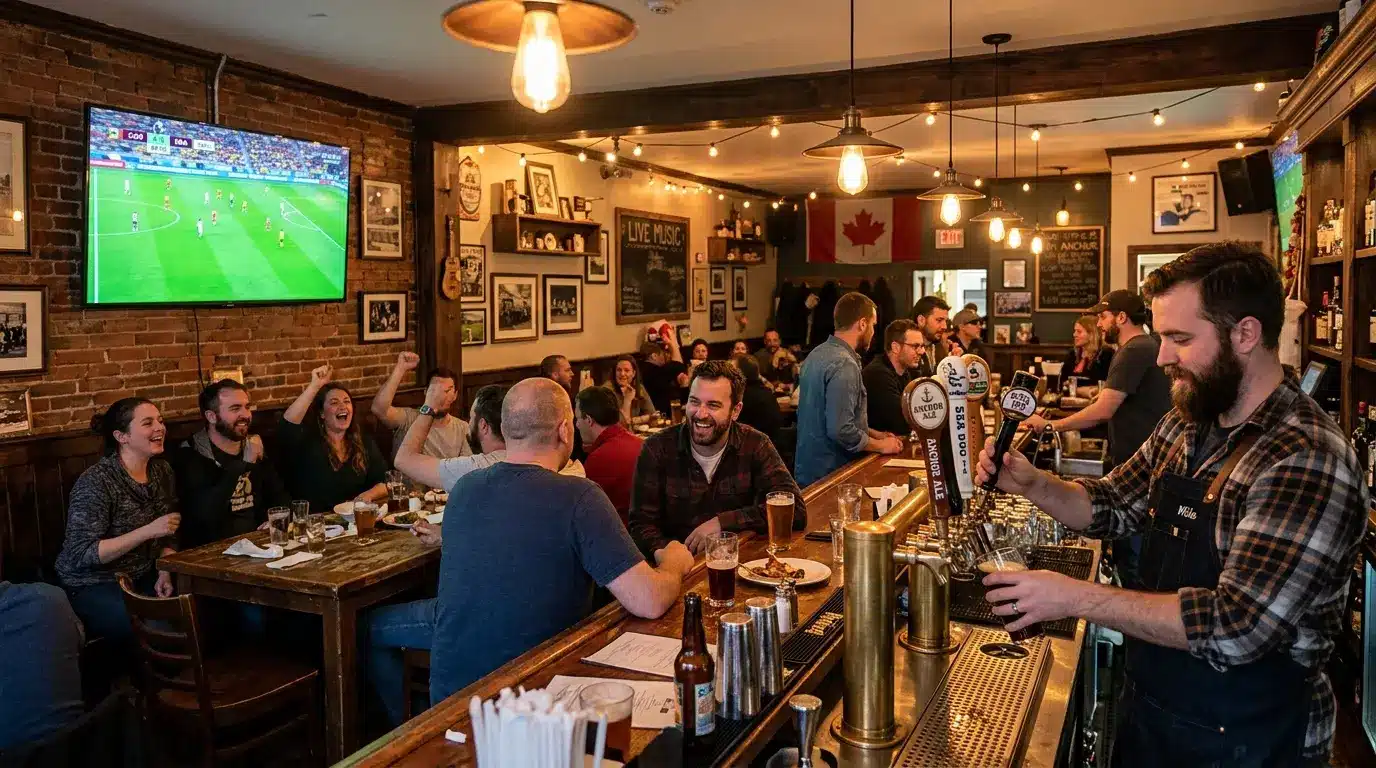
22% of Canadians plan to watch 2026 FIFA World Cup matches at a locally or independently owned business – 11 times more likely than the 2% who plan to watch at a national chain or large venue, according to the 2026 Small Business Pulse commissioned by Merchant Growth, a Canadian financial technology company specializing in small business financing. The consumer survey was conducted by Angus Reid from April 30 to May 4, 2026, polling 1,504 Canadians nationally on summer dining and spending intentions. Among those planning to watch matches outside the home, average expected spending on food and drinks runs $52 per visit – a figure that, across even a modest match-day crowd of 40 patrons, represents roughly $2,080 in single-session revenue.
That demand signal, however, is running into a wall of operating cost pressure that is leaving most small business owners unable or unwilling to invest ahead of it. A parallel Merchant Growth survey of 130 small business owners – conducted May 1 to 19, 2026 – found that 58% expect the World Cup to have no revenue impact compared to a typical summer, and only 37% anticipate a revenue lift. As a commissioned study by a lender with a direct commercial interest in small business financing uptake, the findings merit standard caveats about sponsor framing, but the cost-side data aligns with broader industry trends and warrants attention on its own terms.
Survey Scope Reveals a Consumer Preference Gap That Favors Independent Operators Over Chains
The Angus Reid consumer data captures a structural advantage for independent hospitality operators that does not show up in their own expectations. Canadians watching World Cup matches outside the home are overwhelmingly routing that spending toward independents: the 22%-to-2% preference ratio over national chains suggests that for every patron a chain location captures on match day, roughly 11 are walking into local venues instead. That ratio is not uniform across demographics, and the spending spread by age cohort matters for operators assessing their specific customer base. Gen X expects to spend $60 per visit on average, Boomers $56, Millennials $51, and Gen Z $41 – meaning a venue that skews toward older clientele carries meaningfully higher per-head revenue potential per match.

Broader summer dining intentions reinforce the local preference pattern. 60% of Canadians said they will choose locally or independently owned businesses when dining out this summer, and 40% said they will prioritize local even if it costs more. Price sensitivity remains a countervailing force: 69% cited price and deals as the top factor in their summer dining decisions, compared to 56% who cited supporting local businesses – a gap that signals promotional pricing and value offers will matter in converting intent into actual foot traffic.
Fuel Costs, Utility Bills, and Labor Expenses Are Compressing Margins Before the Tournament Begins
The cost pressures that small business owners are absorbing entering the tournament are not World Cup-specific – they are structural conditions that make event-driven investment feel prohibitively risky. 42% of small businesses surveyed cited fuel cost increases from global trade disruptions as a summer cost pressure, a figure that flows through to food and beverage supply chains via elevated distribution and logistics costs. 37% cited rising utility bills – electricity, gas, and water – and another 37% cited weaker consumer demand, creating a double bind where input costs are rising while the customer base is under financial stress of its own.
Labor costs or minimum wage increases were flagged by 30% of operators, and commercial rent or lease increases by 26%. These pressures compound rather than stack independently: a bar operator absorbing higher food costs, elevated electricity bills for extended-hours operation, and a higher minimum wage faces a margin squeeze on every match-day dollar earned. Restaurants Canada data showed restaurant operating costs rose approximately 9.8% between 2019 and 2023 while average menu prices increased only 7.8% over the same period – a compression dynamic that was already eroding buffers before the current round of trade-related cost increases. The pattern of rising operating costs squeezing small business margins has become a cross-sector condition, not an anomaly confined to hospitality.
Independent Operators Absorb Cost Shocks Without the Purchasing Scale or Financing Leverage That Chains Carry
The structural asymmetry between independent venues and national chains is most visible in how each side responds to an event-driven opportunity. A national chain can negotiate volume pricing on beer, food, and licensed broadcast packages across hundreds of locations, spreading fixed costs and leveraging supplier relationships that a 40-seat neighborhood bar cannot access. Independent operators typically purchase inventory at retail or small wholesale prices, have no centralized marketing function to run event promotions, and are personally liable for financing decisions, creating a risk calculus that favors caution over investment.
That caution is evident in the preparation data. Only 14% of small businesses surveyed have increased inventory or product stock for the World Cup. 14% have promoted their business on social media around the tournament, 12% have extended hours, 10% have hired additional staff, 9% have created FIFA-themed promotions or deals, and just 5% have applied for or accessed financing to fund preparations. The financing gap is not simply a preference – 22% of owners cited a lack of cash or access to financing as the direct barrier to World Cup investment, and 21% said rising operating costs leave no budget for additional spending.
“The World Cup is a major economic moment, but it will not benefit every small business equally. Businesses with the right location, staffing and cash flow may be able to turn increased consumer activity into revenue. But for many owners, rising operating costs and tight margins mean they are being cautious about investing ahead of the opportunity.”
– David Gens, Founder and CEO, Merchant Growth
What the Demand and Cost Data Mean for Operators Evaluating Whether the Tournament Justifies Investment
For an independent hospitality operator trying to assess whether World Cup preparation spending pencils out, the data presents a specific tension. The consumer intent figures are real: if 22% of Canadians follow through on plans to watch at local venues, and average per-visit spending holds near $52, a venue that adds 20 incremental patrons per match across 13 Canadian host-city games could generate roughly $13,520 in additional food and beverage revenue over the tournament run – before accounting for staffing, inventory, and promotional costs. For operators in Toronto and Vancouver, where host-city demand is expected to run well above the national average, the upside case is materially stronger than for operators in non-host markets.
The risk scenario cuts the other way just as concretely. 27% of small businesses surveyed said they expect no increase in foot traffic at all from the tournament. An operator who extends hours, adds staff at elevated minimum wage rates, and increases inventory – then sees match-day traffic run flat – absorbs those fixed costs against an unchanged revenue base. The 55% of small businesses that have already cut spending entering this summer, and the 25% that have delayed hiring, reflect a sector that has largely concluded the risk-reward calculation favors defensive positioning. The broader sentiment context supports that read: 71% of small business owners believe Canada is already in an economic downturn or likely heading toward one within 12 months – down from 83% in 2025 but still a majority view. Operators and analysts tracking small business sentiment indicators will recognize this pattern of structural caution preceding a demand event. Understanding which operating costs can be reduced ahead of a demand surge may matter more than the revenue upside for operators running on compressed margins.
FIFA has projected approximately C$2 billion in GDP activity for Canada from the 2026 tournament, but economists have noted that broadcast rights, corporate sponsorships, ticket revenue, and stadium concession income flow primarily back to FIFA rather than to host cities or local operators. Canada’s Parliamentary Budget Officer has estimated C$1.066 billion in public hosting costs for 13 matches across Toronto and Vancouver – roughly C$82 million per game – with the federal government absorbing C$473 million of that figure. The gap between headline economic projections and what actually reaches independent operators on match day is a material consideration for any venue owner building a business case around the event.
Indicators to Watch
- Municipal patio and extended-hours bylaws in Toronto and Vancouver – Final operating rules for fan zones, patio expansions, and late-night service hours in host cities will directly shape how much match-day consumer spending independent venues can physically capture. Operators outside the immediate footprint of official FIFA fan zones are particularly exposed to regulatory constraints on capacity and service hours.
- Canada’s Parliamentary Budget Officer cost updates – Revised public cost estimates for hosting are expected closer to the tournament and will clarify the fiscal environment in host cities, including any municipal levy or service fee adjustments that filter through to commercial tenants and hospitality operators.
- Monthly CPI data for food service and utility inputs – The 42% of small businesses citing fuel and supply chain costs as a pressure point and the 37% flagging utility bills will be watching whether those input costs moderate or accelerate between now and match kickoffs. Statistics Canada’s monthly CPI releases for food purchased from restaurants and electricity prices are the most direct proxies.
- Consumer spending on food services in Statistics Canada’s retail trade data – Whether the $52 average per-visit spending intent converts into actual hospitality revenue will be measurable in monthly food services and drinking places sales data. A divergence between stated intent and realized spending would indicate that price sensitivity is overriding local-preference sentiment.
- Small business financing uptake from alternative lenders – Only 5% of operators surveyed have accessed financing for World Cup preparations. Whether that figure rises as the tournament approaches – and whether it correlates with revenue outcomes for prepared versus unprepared venues – will be a leading indicator of how the alternative lending market performs during major demand events.