

Amazon Web Services has expanded its Amazon Connect platform into a suite of four agentic AI solutions targeting customer service, hiring, supply chain management, and healthcare administration. The announcement, made in late April 2026, rebrands the original Amazon Connect contact center product as Amazon Connect Customer and introduces three new tools – Amazon Connect Talent, Amazon Connect Decisions, and Amazon Connect Health , each designed to automate workflows that previously required manual intervention. According to AWS, the tools are built to integrate with existing enterprise systems rather than replace them outright.
The expansion arrives as AI automation has moved from a pilot-phase conversation to an active procurement decision for businesses of most sizes. Smaller operators in particular are weighing whether platforms built for enterprise scale can deliver usable automation at the contact volumes and budget constraints that define SMB operations – a question AWS’s announcement addresses in tone but does not fully resolve in pricing specifics.
What Is Actually Changing in Amazon Connect’s AI Capabilities
The original Amazon Connect, launched in 2017 as a cloud-based contact center service (a platform enabling businesses to manage voice and digital customer interactions through AWS infrastructure), has evolved significantly. Early integrations with Amazon Lex for natural language understanding and Amazon Polly for text-to-speech laid the groundwork; the April 2026 expansion moves the platform into agentic AI territory, meaning the systems can plan, execute, and adjust tasks autonomously rather than waiting for explicit human instruction at each step.
The four solutions now comprising the suite each target a distinct workflow:
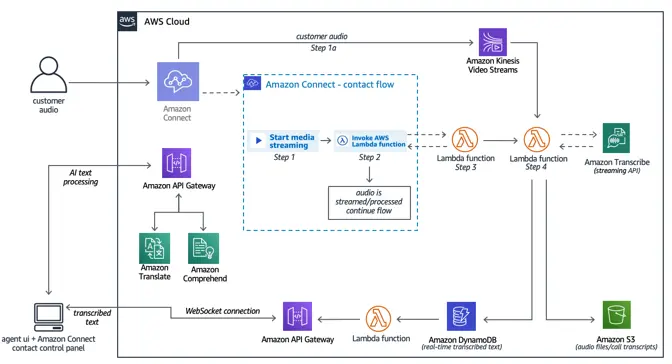
- Amazon Connect Customer – the rebranded core contact center product, now incorporating generative AI for open-ended customer conversations alongside deterministic rules for compliance-sensitive interactions. AWS states the tool supports setup in weeks using new configuration tools, integrating natively with telephony, natural language understanding, and speech recognition systems.
- Amazon Connect Decisions – focused on supply chain optimization, this tool draws on over 25 specialized supply chain tools and what AWS describes as 30 years of Amazon’s internal operational science, including its Supply Chain Optimization Technologies (SCOT) foundation models. It is designed to forecast demand per product and adapt without extensive reconfiguration.
- Amazon Connect Talent – automates candidate screening and interview scheduling, aimed at companies managing high-volume hiring cycles.
- Amazon Connect Health – supports clinical documentation and appointment scheduling in healthcare settings, with AWS noting humans remain in the loop for oversight in sensitive decisions.
AWS describes the systems as functioning as “AI teammates” that learn from enterprise data and refine outputs over time – according to AWS’s own characterization, which has not been independently benchmarked in production environments at scale.
Small Businesses See Promise in Amazon’s New AI Tools, But Hurdles Remain
For small and midsize businesses, Amazon’s expanding contact center tools offer clear appeal. A healthcare clinic managing appointment backlogs, a retailer handling seasonal hiring, or an e-commerce brand fielding customer inquiries could all benefit from more automation.
Amazon Connect has long been attractive to smaller teams thanks to its pay-as-you-go pricing, avoiding the high upfront costs of traditional systems. That model could extend to its new AI features, though AWS hasn’t yet shared detailed pricing.
The bigger challenge may be technical readiness. Tools that rely on “learning from enterprise data” require structured, accessible data, which is something many small businesses lack without prior investment. While AWS says deployments can happen “in weeks,” smaller teams without IT support may face longer timelines. Industry experience suggests vendor claims about ease of setup often assume capabilities not all businesses have.
There’s also limited proof at the SMB level. Amazon’s flagship Connect customers, such as State Farm and U.S. Bank, operate at enterprise scale. Whether similar results can be achieved by smaller teams with fewer resources remains unclear.
What the Industry Is Building and What Operators Can Do Now
AWS is not operating in an uncontested space. Platforms including Zendesk AI and Intercom have built agentic and generative AI capabilities directly into their customer-service tooling, often with SMB-specific pricing tiers and lower integration barriers. The distinction AWS is pressing is infrastructure depth – combining cloud compute, proprietary foundation models, and domain-specific tools (the SCOT models in Decisions, native telephony in Customer) into a single platform rather than layering AI onto a third-party base. Whether that depth translates to a meaningful advantage for operators who don’t need the full stack is an open question. Separately, AWS recently released Amazon Bio Discovery for life sciences researchers, signaling that the Connect suite’s healthcare focus is part of a broader vertical AI push rather than a standalone product decision.
For SMB operators currently evaluating these tools, the practical starting point is a contact volume and workflow audit before engaging with AWS pricing. Specifically: determine whether current support volume justifies per-contact cost exposure, identify which workflows – screening, scheduling, inbound customer queries – are highest-friction and most repetitive, and assess whether existing data systems can support the integration requirements that agentic tools assume. Teams exploring broader technology adoption strategies for small businesses will find that AI platform decisions follow the same cost-benefit logic as any infrastructure investment: the tool’s ceiling matters less than whether the floor of requirements is already in place.
Whether AWS’s agentic Connect suite will prove operationally accessible to smaller teams – or whether its architecture, data requirements, and enterprise reference base mean its real gains accrue primarily to organizations already running at scale – remains the question the April 2026 announcement raises without fully answering.