
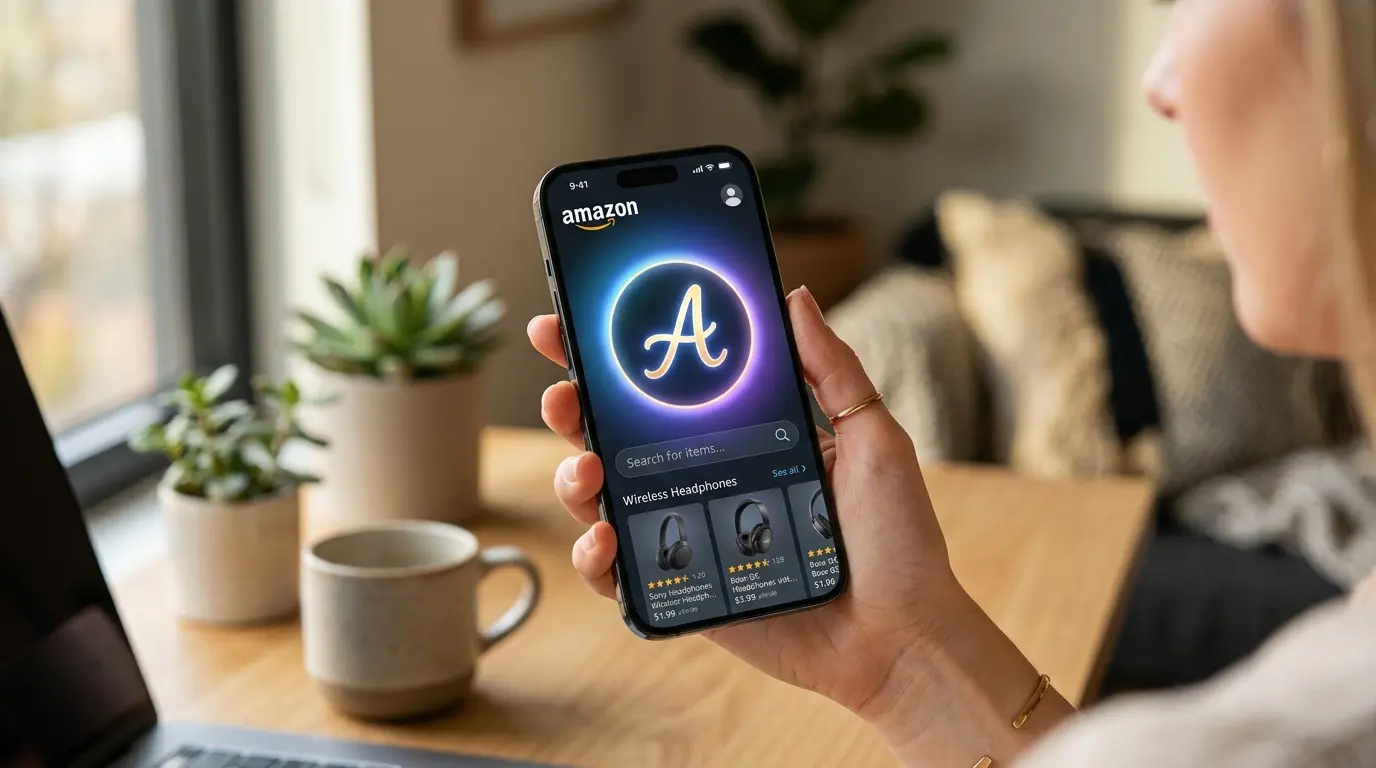
Amazon has retired its Rufus chatbot and replaced it with Alexa for Shopping, a consolidated AI agent that the company describes as capable of handling multi-step purchase tasks – comparing products side by side, scheduling purchases at target price points, and surfacing real-time inventory data – directly within the platform’s search experience. According to Amazon’s own characterization, which has not been independently benchmarked, the tool draws on what the company calls “the world’s largest product catalog” and data generated by over 2 billion weekly customer visits, figures that have not been validated by a third party. The change directly affects product discovery and listing visibility workflows for the roughly 60% of Amazon’s sales volume that flows through third-party sellers.
The replacement comes roughly two years after Amazon introduced Rufus in early 2024 as what it then called an “expert shopping assistant,” positioning the chatbot as its answer to the generative AI wave sweeping e-commerce. Internal metrics cited by analysts suggest Rufus powered recommendations for 10–15% of Amazon’s mobile app queries at peak in late 2025 but stalled at under 5% of total searches, a figure attributed to discoverability problems – not a failure of the underlying model. The consolidation into Alexa for Shopping comes as OpenAI has already embedded a shopping assistant in ChatGPT and as Meta has announced AI-driven shopping features across Instagram and Facebook this year, compressing the window in which Amazon can claim a structural advantage in AI-assisted commerce.
What Is Actually Changing in Alexa for Shopping
Alexa for Shopping merges the conversational query handling from Rufus with the task-execution capabilities of Alexa+, Amazon’s LLM-powered premium voice assistant. The practical result is a system that moves beyond single-turn product recommendations into what Amazon describes as “agentic” behavior – meaning it can execute multi-step instructions such as finding a television under a set price with specific features, comparing reviews, and alerting the user if the price drops to a defined threshold, all within one session.
Users access the tool via a cursive “A” icon appearing in the Amazon website, app, and on Echo Show displays; no Prime membership is required. According to PCMag’s reporting on the launch, the icon will appear in 80% of U.S. search result pages starting May 20, 2026, with voice integration on Echo Show expanding to all models by June 2026. The tool processes queries in under 2 seconds using Anthropic’s Claude models fine-tuned on Amazon’s proprietary data, per that same report – though Amazon has not publicly confirmed the Anthropic infrastructure detail itself.
The structural change for sellers is significant: Amazon is embedding Alexa for Shopping directly into search results so that a conventional product query now surfaces a chat window alongside traditional listings. Rufus‘s recommendation features and shopping history data are being carried forward into the new system rather than discarded, but the interface through which those signals influence purchase behavior has fundamentally shifted. A beta rollout to 1 million U.S. users began May 6, 2026, ahead of the announced full U.S. launch, with EU expansion planned for Q3 2026 pending regulatory review, according to Amazon’s own published timeline.
Daniel Rausch, Amazon’s Vice President of Alexa and Fire TV, framed the competitive distinction this way in a May 13 briefing:
“As I’m using it, I’m just realizing why other AI efforts have struggled with shopping because it’s not just scraping web results and then putting things in a conversation.”
The claim points to Amazon’s differentiation argument: access to structured product data, verified customer reviews, and real-time inventory signals that web-scraping competitors cannot replicate. Whether that advantage produces measurably better purchase outcomes for users has not been independently tested at this stage of the rollout.
The Opportunity and the Access Barriers for Smaller Operators
The clearest upside for smaller sellers is passive: any merchant listed on Amazon gains potential exposure through an AI layer that surfaces products in response to conversational queries, without requiring the seller to build or maintain the tool itself. For sellers with strong review volume and well-structured product listings, Alexa for Shopping‘s reliance on catalog data and customer feedback could amplify existing organic visibility in ways that cost nothing incremental.
The barriers, however, are less visible but worth examining. Alexa for Shopping introduces what analysts at MediaPost have described as “AI placement auctions” – a dynamic in which listings optimized for Rufus-era keyword logic may lose visibility unless they are restructured for conversational, intent-based queries. A seller whose listing ranks well for “wireless earbuds” in a keyword search may not surface for “best wireless earbuds for running under $100,” which is the kind of natural-language query the new system is built to parse. Sellers on Amazon’s Seller Central forums have flagged this as a potential disruption to ad ROI, with at least one high-volume advertiser warning that algorithmic selection could override paid placement in ways that are difficult to predict or optimize against. These reactions reflect individual operator concerns and are not drawn from controlled measurement data.
Amazon has stated that Alexa for Shopping will show ads “where relevant and when such additions improve shopping experiences” – a characterization that has not been further specified in terms of auction mechanics, impression weighting, or how the system defines relevance. Since Amazon generates most of its advertising revenue from sponsored product listings, the incentive to preserve that revenue stream is clear; how it balances AI-driven organic placement against paid promotion remains undisclosed. For context on how Amazon’s broader AI platform strategy is evolving across its product suite, the pattern suggests consolidation and vertical integration rather than opening infrastructure to third-party customization.
Smaller sellers also face a data asymmetry that they cannot close. Alexa for Shopping‘s personalization engine draws on individual shopping histories and behavioral signals at a scale that only Amazon can aggregate. Merchants have no visibility into how their products score within the model’s ranking logic, nor do they have tools – at least as of the May 2026 launch – to audit why a product surfaces or fails to surface for a given query type. Forrester analyst Dipanjan Chatterjee has estimated that embedding Alexa directly in search could drive 20–30% more conversions from AI queries, per reporting by GeekWire – though that projection is drawn from analyst modeling, not from controlled A/B data on the new system’s actual conversion lift.
What the Industry Is Building and What Sellers Can Do Now
Amazon’s move reflects a broader industry convergence: major platforms are embedding transactional AI directly into discovery interfaces, collapsing the distance between a search query and a completed purchase. OpenAI‘s integration of shopping and cashback features into ChatGPT and Meta’s announced AI commerce layer across Instagram and Facebook signal that search-to-purchase compression is becoming a platform-level infrastructure priority, not a feature add-on. For Amazon sellers, this means the competitive environment is shifting faster than a single platform update cycle.
Sellers evaluating the implications of Alexa for Shopping‘s rollout have several concrete areas to address:
- Audit product listing language for conversational query alignment – em dash – listings written for keyword density may underperform in a system parsing intent-based, sentence-length queries; review top-performing search terms and map them to natural-language equivalents.
- Prioritize review volume and recency – em dash – the system draws heavily on customer review data to generate recommendations, making review acquisition strategy more directly tied to AI visibility than under the prior keyword-ranking model.
- Monitor sponsored placement performance after May 20 – em dash – the full U.S. rollout date is the first clean measurement opportunity to detect whether paid listing impressions shift in categories where AI-surfaced results appear prominently.
- Attend Amazon’s June 2026 seller webinars on listing optimization – em dash – Amazon has indicated it will host guidance sessions specifically on adapting to the new AI search environment; these represent a direct channel to Amazon’s stated best practices before third-party interpretation adds noise.
- Evaluate product titles and bullet points against multi-condition queries – em dash – queries like “under $X with feature Y and feature Z” require that all conditions be explicitly present in structured listing fields, not buried in long-form descriptions.
- Track the trust signals that drive AI selection – em dash – research on how shoppers verify products before purchasing online suggests that third-party validation, detailed specifications, and clear return policies influence AI-assisted purchase decisions alongside raw review scores.
Whether the conversion gains and visibility improvements Amazon has described – drawn from internal data and early beta metrics that have not been independently verified – will materialize at comparable rates for smaller third-party sellers with thin review histories, limited listing optimization resources, and no existing Alexa+ integration strategy, as opposed to high-volume merchants already optimized for Amazon’s algorithmic signals, remains the question the May 2026 launch raises without fully answering.