
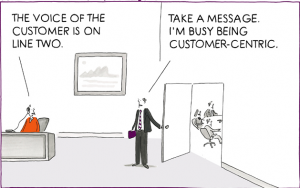
 The price of a product, the brand value and the other pillars of marketing are no longer the most important factors in a consumer’s selection process. At a certain level of affluence the “absolute value” of experience, a company is likely to deliver, becomes the pivotal point in making the selection. Global trends point to a dramatic growth of consumers who are reaching, or about to reach, that level. Therefore, customer-centric companies are likely to outperform their competitors, who’s leaders cannot see beyond the next quarter’s financial results.
Customer centricity starts with realization that your company cannot deliver a superior customer experience to anybody who wants to buy your product or service.
Customer centricity is about:
- knowing who your best customers are – beyond demographics and persona definitions.
Regardless of the type of business – B2B, B2C or any other combination of letters, it is people who decide whether they had a good experience as your customers or they should try someone else. These people share their opinions with others, like they always have. However, now these opinions have as much, or more, impact on shoppers as advertising.
- knowing WHY your best customers buy what you are selling.
According to Peter Drucker –
“The customer rarely buys what the company thinks it is selling him”.
It is critical to understand what “job” they “hire” your products to do. Go beyond sketchy marketing requirements, and deliver the ultimate simplicity of experience to perform that “job”.
- exclusivity – it may not be politically correct or culturally easy to accept, but a company cannot deliver a top quality experience to any customer – only to those it is best focused on to serve profitably.
That means it is better for such a company’s culture, it’s employees, it’s target customers, and the consumers at large to clearly communicate what type of customers it will not serve, because it cannot deliver the quality of experience they deserve. The best example I know is USAA that leads every chart as the top customer experience provider, but will not take your business if you are not a member of the military family.
- measuring the performance of each and every department in alliance with the overall goal of delivering superior customer experience profitably.
Enterprises deliver operational efficiencies through departmental silos that can easily lead to fragmentation of customer experience. Business intelligence data warehouses can integrate internal data flows to produce a holistic view of the enterprise performance, in terms of growth and efficiencies. However, without connecting it all to customer’s perceptions of their experiences, the enterprise’s sustainable effectiveness cannot be measured.
Customer centricity is not a project or corporate initiative. It may or may not involve investment in technology and if it fails, it is an ultimate failure of the company’s leadership and not IT, Customer Service or any other of its departments. Customer centricity is a cultural transformation that leads to embracing a customer into the inner circle of the company’s stakeholders. Without customers, employees and shareholders – there is no company.